How AI Flags Possible Compliance Violations in Calls
By Track Agent · Published · Updated
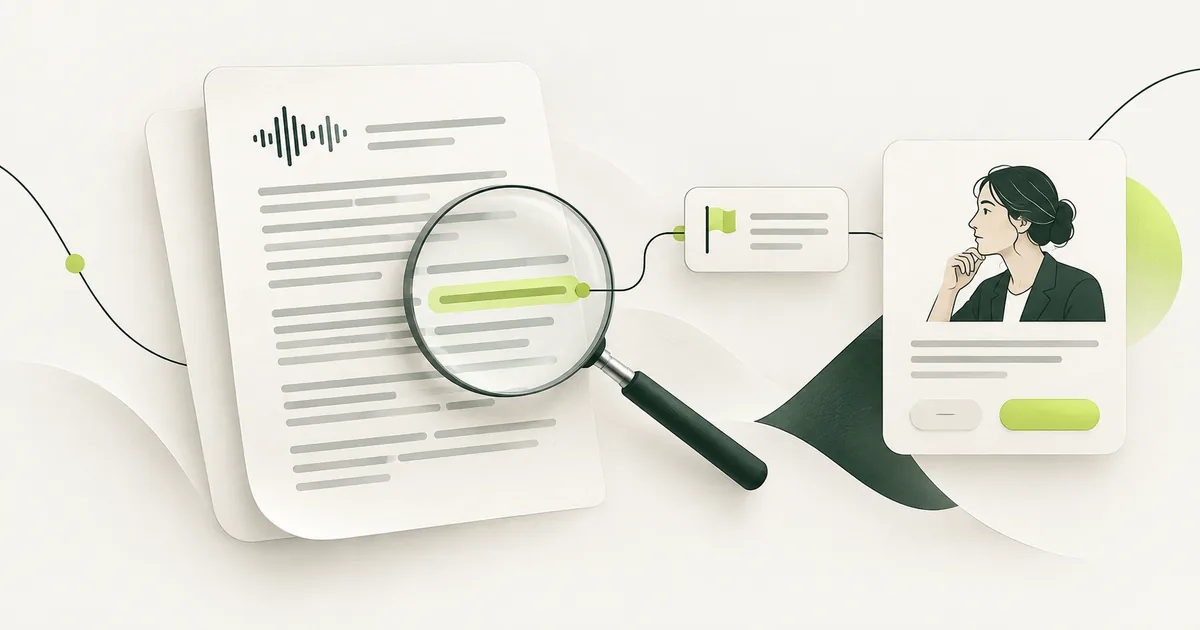
AI compliance violation detection compares available call evidence with defined rules and highlights possible failures. The result should be a reviewable concern, not an unexplained accusation or a guarantee that unflagged calls were compliant.
This guide focuses on practical failure patterns. The broader compliance monitoring framework explains how to establish applicability, rule ownership and a review program. The examples below are hypothetical and require the policies and legal requirements applicable to the actual operation.
Missing or Incomplete Required Information
A rule may require particular information before a defined step. The detector needs the applicable rule, the relevant part of the call and enough timing context to assess it.
If the recording begins late, “not found” may mean insufficient evidence rather than a confirmed omission. If the transcript is uncertain, check permitted audio before making a consequential judgment. Record what was observed and what remains unknown.
For AI callers, distinguish text prepared for speech from speech that actually reached the caller. An interruption or disconnect can prevent a complete disclosure from being heard.
Statements That Conflict With Approved Policy
An agent might describe a refund, contract term or product capability incorrectly. Compare the exact statement with the policy version effective for that customer and call, including any applicable exception.
A keyword match is not enough. “We do not offer a lifetime guarantee” should not be flagged as offering one. A reviewer needs the surrounding exchange and the source used to judge the statement.
Do not convert a policy mismatch automatically into a legal conclusion. Preserve the distinction between an internal rule, a suspected regulatory issue and a confirmed finding under the applicable requirement.
Unauthorized Actions or Unverified Identity
A transcript can show that an agent asked a verification question. It may not prove the verification succeeded or that the requested account change was permitted.
Check the authorization event and the action result. For an AI caller, enforce permissions in the service performing the action, rather than relying only on an instruction to the model. A post-call flag is a detection layer; it cannot replace a control needed before an action.
The CRM integration guide explains why record matching and caller authentication must remain separate.
Refusals and Stop Requests
Distinguish an objection, a request for clarification and an explicit request to stop contact. Use the campaign's approved procedure to determine the required response and system update.
Review both the acknowledgment and the follow-through. If the customer says “do not call me again,” a polite response is not evidence that the suppression record was updated. Track uncertain or failed writes and assign a responsible owner.
The detector should not recommend continued persuasion after a stop condition. Test indirect and varied wording while preserving human review for ambiguous cases.
Sensitive Information Outside the Approved Flow
Define which data the workflow should collect and where it may be stored. If unexpected sensitive information appears, use the approved handling, access and retention procedure rather than copying it into ordinary coaching notes.
Detection and redaction need their own validation. A clean-looking transcript should not be assumed free of sensitive data solely because a filter ran. Confirm applicable requirements with the responsible compliance or legal team.
Give Reviewers a Complete Finding
| Finding field | What to include |
|---|---|
| Observation | The statement or event that triggered concern |
| Rule | The applicable policy or requirement and version |
| Evidence | Relevant excerpt, timing and action records |
| Limitation | Missing, conflicting or unreliable inputs |
| Review state | Suspected, under review, confirmed, dismissed or unresolved |
| Follow-up | Owner, action and completion evidence |
Keep reviewer changes with reasons. Repeated dismissals may reveal a weak rule, while missed issues found in random samples may reveal a detection gap.
Test Both Mistakes and Correct Behavior
Include compliant examples, known failures and ambiguous cases. Test whether the system distinguishes quoted language, negation, missing audio and actual action failures. Measure false flags and missed findings separately.
Use a combination of risk-based review and unflagged samples. “No alerts” is only useful after you know the expected evidence arrived and the criteria were assessable.
For a call QA evaluation, bring a rule and a boundary case. Ask how the finding is explained, reviewed and corrected, rather than asking for a universal compliance percentage.
Frequently Asked Questions
Can AI make a call compliant?
No. It can help detect possible issues and support review. Appropriate process design, controls and accountable decisions are still required.
Does this replace legal review?
No. A legal or compliance specialist must determine applicability and approve the relevant requirements. The evaluation implements and checks defined criteria; it does not create the law.