10 Sales Call Mistakes and How AI Can Help Find Them
By Track Agent · Published · Updated
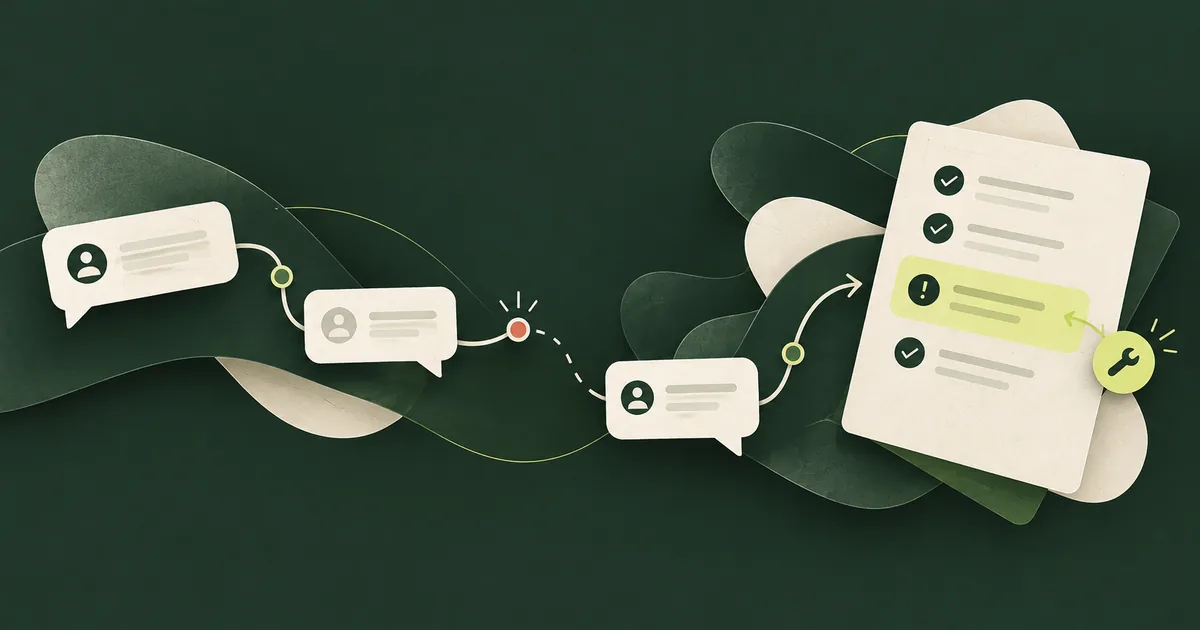
A missed qualification question, an unsupported promise and a failed booking are different sales call mistakes. They need different evidence and different fixes. AI analysis can help organize the review, but a flag still needs enough context to support the conclusion.
The ten examples below are hypothetical. They apply to human sales calls and, where indicated, AI qualification calls. None represents a measured TrackAgent customer result or a promise that every mistake will be detected.
1. Pitching Before Understanding the Need
An agent explains features before clarifying why the prospect called. Look for the sequence of questions and answers, not simply a count of questions. The prospect may already have explained the need without being asked.
A useful correction is to confirm the relevant problem and constraints before choosing a product explanation. Score whether the need was established rather than rewarding a fixed number of discovery questions.
2. Missing a Qualification Requirement
The call sounds positive, but a required fit condition remains unknown. Compare the conversation and recorded fields with the approved campaign criteria. A blank field could mean the question was skipped, the answer was unclear or the write failed.
For an AI caller, distinguish an actual customer answer from a model inference. An unknown requirement should remain unknown rather than being filled with a plausible value.
3. Answering the Wrong Objection
A prospect says their budget resets next quarter; the agent responds with a discount explanation. Review the surrounding exchange to distinguish timing from price or fit. Sentiment alone cannot establish the objection.
Coach a clarifying question before a response. The objection detection guide explains how to evaluate both detected concerns and missed ones.
4. Interrupting at the Wrong Moment
Repeatedly speaking over the buyer can prevent discovery, but a transcript alone may hide overlaps. Use reliable speaker timestamps or audio where permitted. Distinguish a brief acknowledgment from cutting off an answer.
For AI callers, test whether incoming speech stops the agent's output and whether it resumes with the right context. Counting punctuation marks is not a valid interruption measure.
5. Making an Unsupported Promise
An agent offers a guarantee or return condition that is absent from approved policy. Compare the exact statement with the policy version applicable to the call. Do not assume a confident explanation is accurate.
The correction is an approved answer or escalation, not a more persuasive version of the same unsupported claim. Keep this finding separate from the average sales-quality score.
6. Treating a Refusal as an Objection to Overcome
“Please stop calling me” needs a different response from “I need more information.” Review both the words and the workflow that follows. The next action should honor the applicable stop or suppression procedure.
Do not reward persistence after an explicit refusal or opt-out. Test that a stop request reaches the system responsible for future contact; a polite acknowledgment alone does not prove it was recorded.
7. Ending Without a Clear Next Step
“We'll be in touch” leaves ownership and timing unclear. Look for agreement about what will happen, who will do it and when, where appropriate to the call. A buyer who declines further contact should not be penalized as a missing follow-up opportunity.
Evaluate the next step against the workflow. An AI qualifier may be responsible for a meeting or a handoff, while a human account executive may own a proposal.
8. Announcing a Booking That Did Not Complete
This failure may be invisible in a transcript-only review. Compare the agent's confirmation with the calendar response and the resulting event. A timeout creates uncertainty; it is not confirmation of either success or failure.
Reconcile the operation before retrying so the system does not create duplicates. The agent should accurately describe a pending or failed outcome and use the approved fallback. See CRM and action integration.
9. Writing the Wrong Customer or Deal Record
Shared phone numbers, duplicate contacts or multiple open opportunities can create a misleading match. Review the record identifiers and matching evidence, not only whether a CRM update exists.
Record matching also does not prove that the caller is authorized to access or change an account. Keep customer verification and permissions as separate checks. Correct the record before using it for coaching or revenue attribution.
10. Attempting a Handoff Without Confirming Connection
“I'll transfer you” is an intention. A transfer request is an attempt. The customer reaching the correct person is a separate event. Review the handoff result and what the caller heard if the destination was unavailable.
For AI callers, define a fallback that preserves context and sets an accurate expectation. For human reps, inspect both the procedure and the receiving team's availability before treating the issue as a coaching failure.
Prioritize the Findings That Change the Next Action
Start with unauthorized promises, ignored stop requests and false completion, then address recurring qualification and conversation gaps. Assign a reviewer, preserve the supporting evidence and let the agent dispute an incorrect interpretation.
Measure improvement on later relevant calls using the same rubric. Track business outcomes separately; a better reviewed behavior does not by itself prove a conversion increase. The sales evaluation guide describes a controlled pilot.
Use one of these failure cases when discussing TrackAgent's sales workflow. Ask to see how the call, action result and QA finding would be connected, and confirm the supported scope.
Frequently Asked Questions
Can AI detect all sales mistakes?
No. Detection depends on the evidence, criteria and evaluation quality. Keep missing-data states, human review and sampling for missed issues.
Should every mistake become a coaching task?
No. Some findings identify a policy, integration or staffing problem. Assign the fix to the owner who can actually change it.